
The method.
BrandRAG is how Linkki turns information already inside a business into AI systems that perform.
Why architecture decides the outcome.
A model can only work with what it can find. What it finds depends entirely on how the underlying knowledge has been organised.
BrandRAG organises it deliberately, in the voice and rules of the business, before the technology comes anywhere near it.
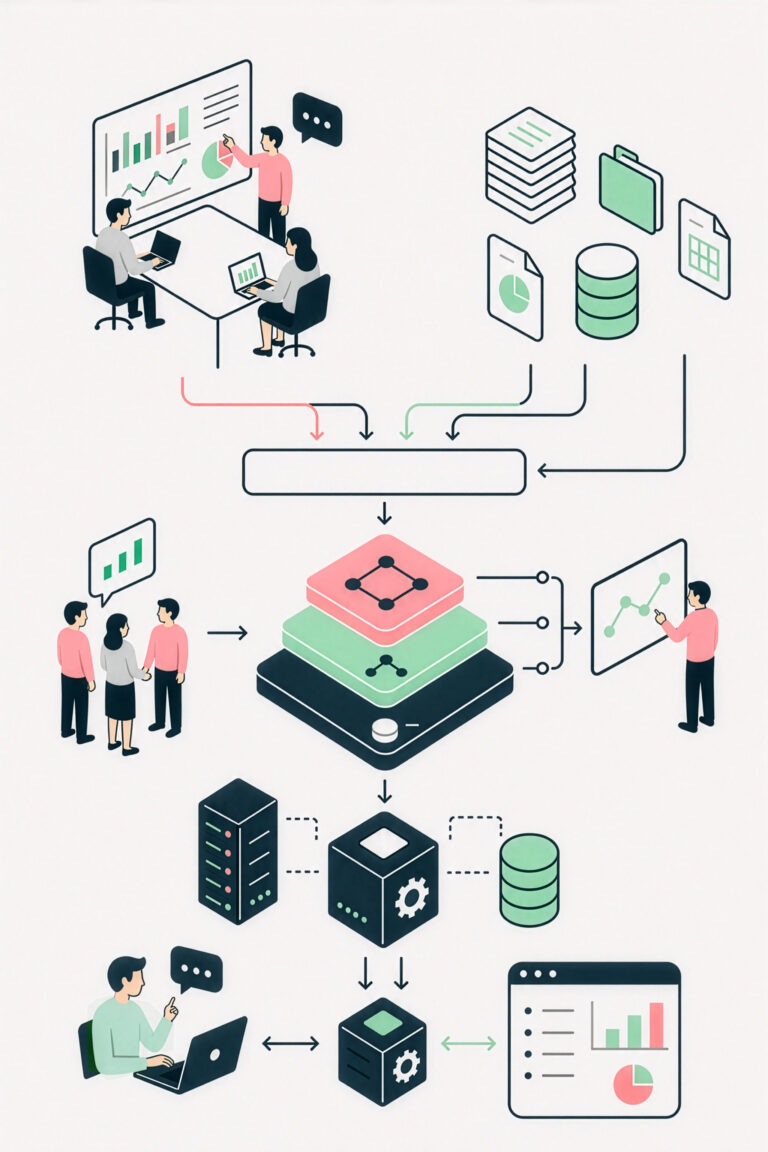

Strategic review.
The first phase is capturing what the business actually knows. Not only the documents that already exist, but the knowledge underneath them: the experience of senior staff, the reasoning behind the rules, the answers people give when customers ask the questions that aren’t in the FAQ.
Most of this knowledge has never been written down. Some of it lives with people who joined twenty years ago and will retire in five. Some of it lives in the daily decisions a small group of experts make without thinking about it. Much of it is essential to a system that has to behave the way the business does.
We run elicitation sessions with the people who hold this knowledge. We translate what they tell us into a form the system can use. Then we test what we’ve captured against the questions the business actually has to answer, and we keep working until the answers become brand assets.

Architecture.
The second phase is structuring the captured knowledge so the system surfaces the right answer first.
A standard retrieval system finds information by similarity: it looks for content that resembles the question. That works when the right answer happens to be the most similar content. It fails when the most similar content is wrong, or out of date, or written for a different audience, or one of three competing versions of the same answer.
BrandRAG architecture solves this differently. The information is organised into a hierarchy that reflects what the business actually trusts, what carries weight, and what the system should reach for first. Reliability beats similarity. The structure carries the judgement of the business into the behaviour of the system.

Engineering.
The third phase is building. By this point, the architecture has decided what gets retrieved and how. The engineering work is to apply the right tools fitted to the architecture above.
Pipeline, retrieval logic, voice layer, integrations, monitoring. Standard tools, applied consistently. The technology choices are usually unsurprising. The work is in how they fit together with the architecture upstream.
The systems we deliver run well, and keep getting better. They’re maintained by people who understand both the architecture and the engineering, because both halves of the work are visible to the people maintaining them.
What makes it different.
Three things separate BrandRAG from the standard approach to RAG.
DISTINCTION 01
The order of the work.
Architecture before engineering, every time. Tool selection happens last, not first. The information layer is finished before any code is written.
DISTINCTION 02
The structure of the knowledge.
Information is organised so reliability is the dominant signal, not similarity. The most trusted answers are surfaced first. The supporting content sits behind, ready when it’s needed.
DISTINCTION 03
The strategy layer.
Knowledge design and systems design make the architectural decisions together before anything is built. The system that gets delivered reflects human judgement, not just process.
HOW WE THINK ABOUT AI
Probabilistic geometry.
What AI models do isn’t intelligence. It’s geometry. They place language in a high-dimensional space and calculate proximity. Which word sits near which. Which answer sits near which question. Which idea sits near which other idea.
Probabilistic geometry is the more accurate frame, and understanding it changes how we build.
The principles that Linkki is built on.
A few things we hold to across every engagement.
Information first,
technology second.
The shape of the answer depends on the shape of the source. We never let the technology dictate the information architecture.
Confidence
requires accuracy.
A system that produces confident wrong answers is worse than no system at all. Reliability is engineered in from the start.
Human judgement
throughout.
Machines handle scale. People handle judgement. The two work together, not one in place of the other.
Talk to us about
the method.
