
CLIENT: Tāwhia Copyright Aotearoa, New Zealand
PRODUCT: Public Facing AI Assistant
WHERE: Tāwhia Website
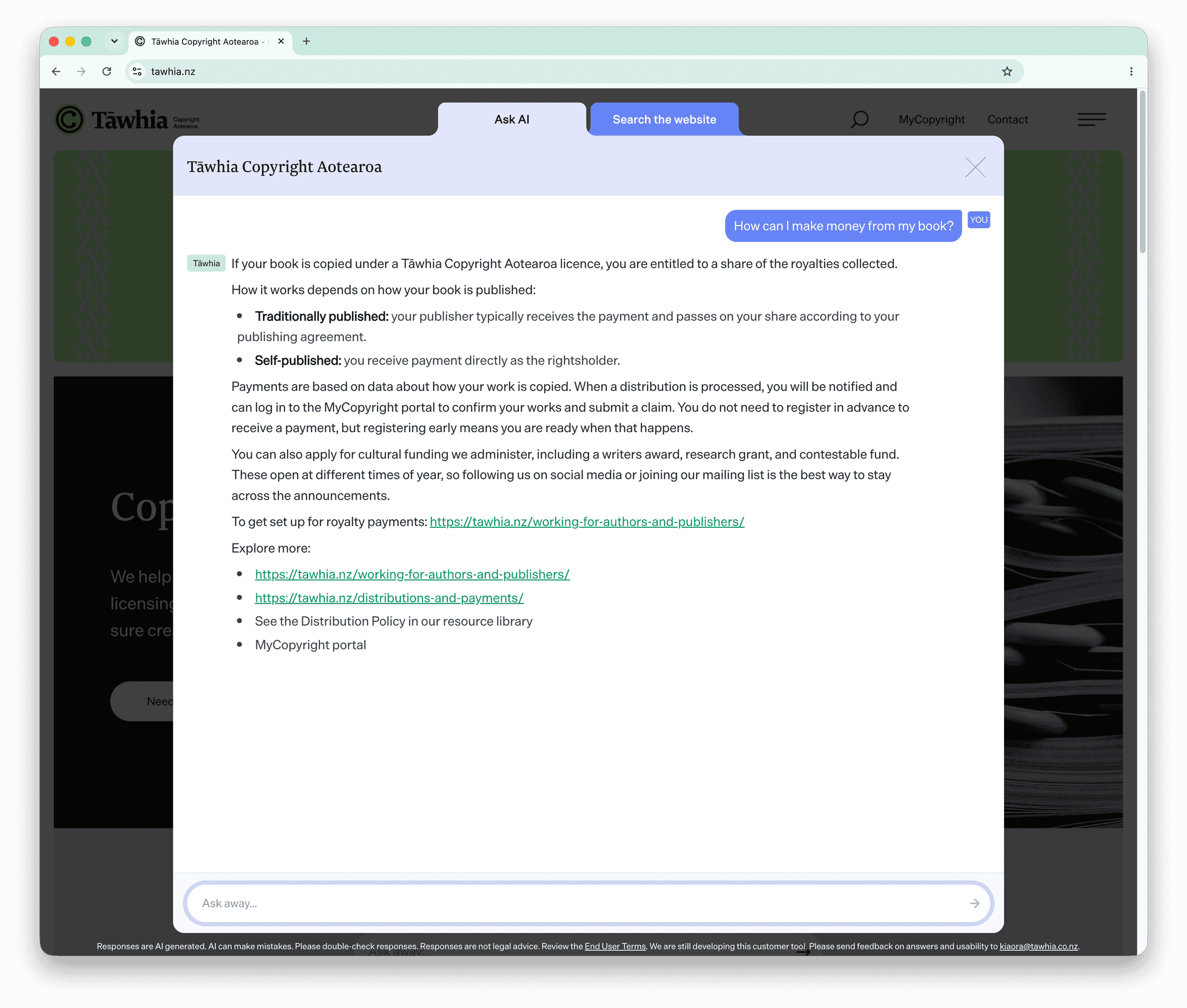
Most not-for-profits run pretty lean. Tāwhia Copyright Aotearoa, New Zealand’s copyright collective management organisation, handles a growing volume of questions from creators, rights holders, licensees and the copyright-curious. Expanding the size of their team answering these questions just isn’t viable.
Part of the increase in questions is due to AI. A lot of people get in touch because they’re worried about AI using their work, which makes it ironic that AI is what helps answer them. But that’s the world we live in. People expect an instant, plain-language answer to anything, and they ask more, because asking has become frictionless. The result is more questions for a team that has no option but to keep up.
The assistant we built for Tāwhia does two jobs. It answers, and it triages.
Straightforward questions get a clear, accurate response on the spot. Anything that needs a human: an active dispute, a contract question, specific legal advice, gets pointed to the right place. The busy Tāwhia team only sees what genuinely needs their valuable attention.
The part that makes it trustworthy is the layered approach.
For most questions, the assistant generates an answer from an approved knowledge base: factsheets and articles written by Tāwhia, plus the Copyright Act itself. Nothing is invented from general knowledge, which is critical, because New Zealand copyright law differs from other countries in ways that AI often misses.
But some answers are too important to paraphrase. The experts at Tāwhia have answered these questions for years, so for the ones that matter most, the system serves their exact words rather than its own version. No reshaping and no making shit up, because a small change to a legal point can make a massive difference.
So, if you want to know whether you own the copyright in that artwork you illegally painted on a public wall, no problem, ask here.
What is a RAG (retrieval-augmented generation) assistant?
It’s an AI assistant that answers from a knowledge base you control, rather than from whatever it absorbed in training. It retrieves the relevant approved material first, then writes the answer from that. For the Tāwhia build, every response traces back to their factsheets, articles and the Copyright Act 1994, not to general knowledge.
Can an AI assistant answer questions reliably without making things up?
Yes, if it’s built to. The accuracy comes from grounding it in approved content, and for the answers that matter most, serving expert-written responses word for word. The model isn’t inventing from memory, it’s working from a source that’s already been checked.
Can a small or not-for-profit team use AI to keep up with enquiries?
That’s often where it earns its keep. Lean teams get more questions than they can answer well, and the volume is climbing as people expect instant answers to everything. An assistant handles the straightforward ones and points the rest to a human, so the team only sees what genuinely needs them.
How do you keep an AI assistant accurate on legal or technical topics?
A layered approach. Most questions are answered from an approved knowledge base, so nothing is invented. The high-stakes ones are served verbatim from expert-written answers, because on a legal point a small change in wording can change the meaning. New Zealand copyright law, for one, differs from other countries in ways general-purpose AI often gets wrong.
Does an AI assistant replace human experts?
No, it carries their expertise further. The best answers still come from people who know the subject. The assistant makes those answers available instantly, day or night, and knows when to hand a question to a human rather than guess.
Linkki builds BrandRAG systems: branded, retrieval-first AI assistants built on structured, verified source material, with strict guardrails and continuous auditing.

Or give us a call on +64 21 280 2773
Or give us a call on +64 21 280 2773