
Check, check 1,2,3.
Is every field signed off?
Do the issue dates line up across the report?
Does the register match the count in the executive summary?
CLIENT: Accurate Consulting
PRODUCT: Report document checker
WHERE: Internal tool
The problem
Accurate Consulting is one of New Zealand’s largest independent asbestos consultancies. Its reports carry serious weight. Schools, hospitals and government sites act on what they say, so every report is checked and rechecked, thoroughly, before it leaves the building.
That checking takes time. Confirming a finished report is correct, line by line, register against summary, plan against site description, is careful and slow. As the volume grew, that first check became the bottleneck. Not a quality problem, a time problem. The reviewer’s attention is the scarce resource, and Accurate Consulting wanted to protect it, not replace it.
The system
We built a checking layer that runs before a report reaches the human reviewer. It reads each draft against itself: sign-off fields, date order, reference numbers, register counts, room names matched across plans and appendices. The mechanical consistency work a person can do but really shouldn’t have to.
It flags what might need a second look. The reviewer still makes every call. They just start further down the track.
Sooner rather than later
Nothing changed about the final reports. They were right before and they are right now. What changed is the distance between first draft and final send. The first pass that used to take an afternoon, or so, now runs autonomously within minutes, and the reviewer spends their valuable time on judgement calls instead of confirming mandatory detail.

Got a report waiting in the queue? Let’s discuss how we can turn hours of work into just seconds.
By the numbers
20 automated cross-reference checks, run against every draft report before a human reviewer opens it.
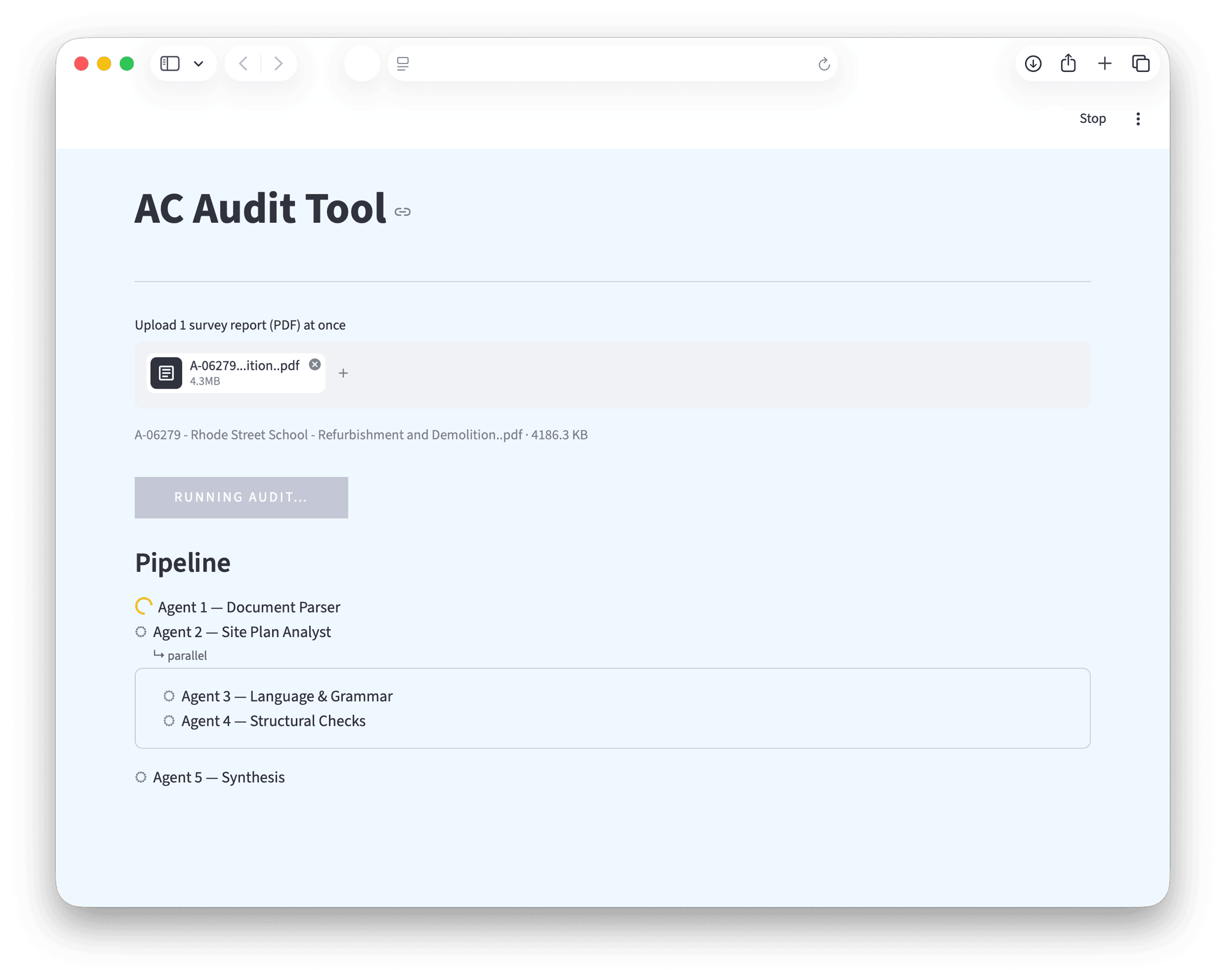
5 specialist agents in the pipeline, each with a single responsibility: parse the document, read the site plans, check the language, cross-reference the structure, synthesise the findings.
2 sources of truth anchoring every check: the Asbestos Survey Plan table and the Appendix E laboratory certificates. Nothing is judged against the AI’s opinion, only against what the report itself declares.
16 canonical fields extracted from the survey plan and verified across the cover page, executive summary, methodology, and appendices.
93 previously audited reports and 1,179 reviewer annotations informing the fault checklist.
4 finding categories in the output: Inconsistency, Risk Scoring, Plan vs Register, Language and Spelling.
2 agents running in parallel once plan extraction completes, orchestrated in LangGraph with full LangSmith tracing on every run.
Every finding delivered with a location, a plain-English description, and a specific fix. The synthesis layer is barred from inventing findings; every output traces to a detected fault.
Quick answers
What is a pre-QA check for a report?
It’s an automated first pass that runs before a human reviewer sees a draft. It reads the report against itself and flags anything that needs a second look, so the reviewer starts from a checked document rather than a blank one. For the Accurate Consulting build, it handles the mechanical consistency work, sign-off fields, date order, register counts, room names across plans and appendices, and leaves every judgement call to the person. The report was going to be checked anyway. This just gets the checking started faster.
Can AI check a document for errors before a person reviews it?
Yes, when it’s built to check rather than to evaluate. The Accurate Consulting tool doesn’t grade the report or rewrite it. It verifies specific things: is each field populated, do the dates line up, does the register match the executive summary count, is a room named the same way on the plan and in the appendix. Bounded checks with clear answers, run in a few minutes, before a person spends their time on the parts that actually need judgement.
Does an automated checker replace the human reviewer?
No, it clears the runway for them. The reviewer still makes every call and signs off every report. What changes is where they start. The obvious consistency checks are already done, so their attention goes to the interpretive work a machine can’t do. On a report that carries legal and safety weight, the human stays in the seat. The tool just hands them a head start.
What kinds of errors can an automated report check catch?
The consistent, mechanical ones. A field left blank, a date out of order, a reference number that doesn’t match across the cover and the footer, a room spelled two ways, a register count that doesn’t reconcile with the summary. These are the checks a careful person runs by hand every time, the same way on every report. Handing them to code makes the pass faster and frees the reviewer for the errors that need a trained eye.
How fast is an automated pre-QA check?
Fast enough to change the shape of the day. A first pass that used to take an afternoon now runs in just a minute or two. Nothing about the standard drops, the report is held to the same bar it always was. The tool doesn’t lower the checking, it removes the wait, so a finished report spends less time sitting in the queue and more time in front of the client.
Linkki builds custom AI tools that fit the way your business already works: automating the mechanical parts of your workflow, with strict guardrails and every output traceable to a source.
